
Notes from the Field No. 3: "Just Talking to People"
Interviewing: A Labor of Love

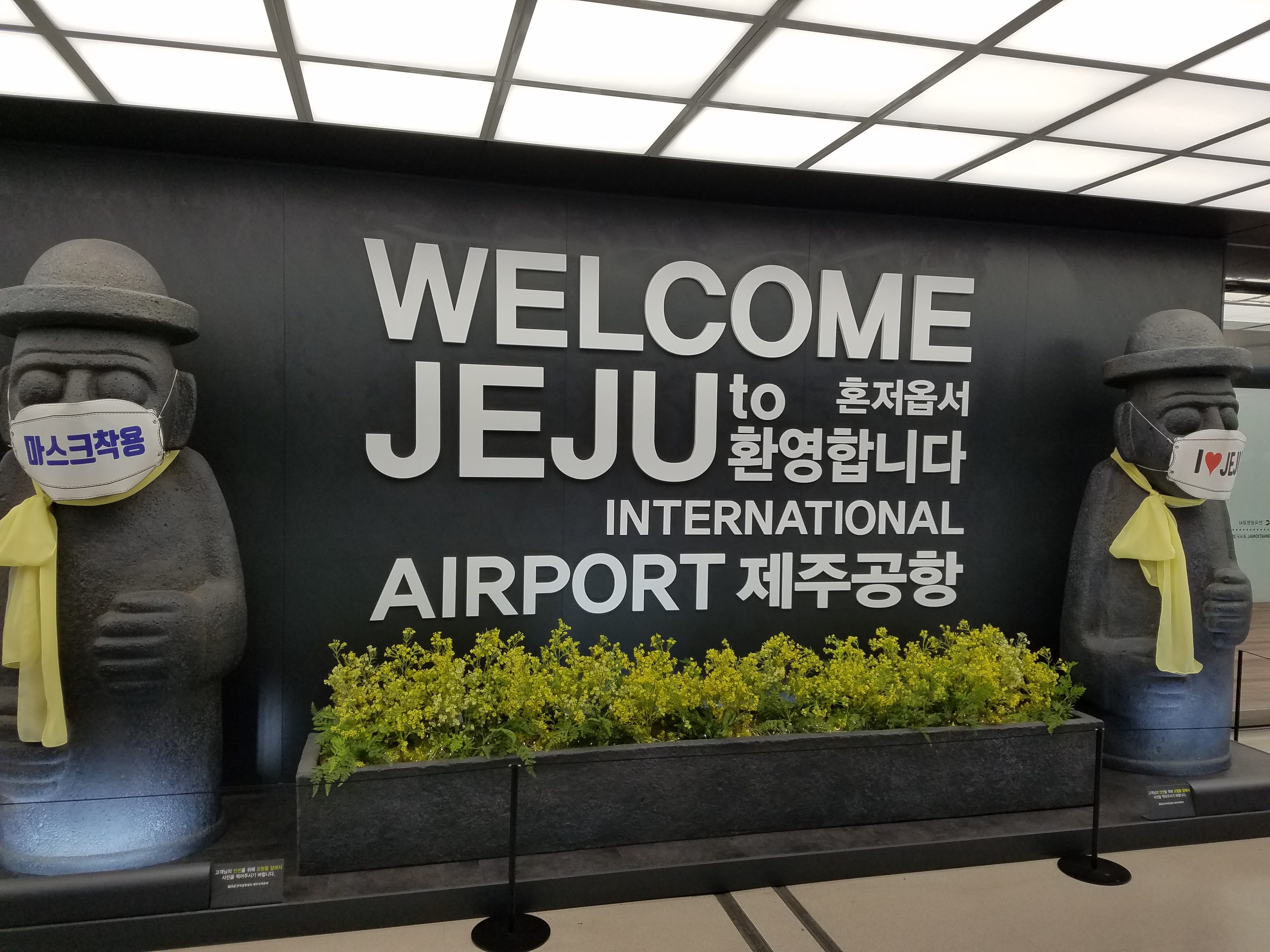
Caption: “Welcome to Jeju International Airport” sign taken on my fieldwork trip to Korea in 2021
Some of my most formative experiences in graduate school that have helped shape the scholar and teacher that I am today have come not from “successes” but from rejection (I know many agree with this sentiment). As a graduate student, I was (and I am) fairly ambitious when it comes to publishing my work, especially in academic journals, and as such, I wrote a lot, submitted a lot, and was rejected a lot.
I have been thinking about one particular instance as I conduct fieldwork in South Korea, primarily to conduct interviews. Even before I was ABD, I worked on a short paper with a friend that involved using interviews to build maps that could be used for geospatial analysis, especially for spatial units that do not conform to a political boundary. For example, if one wanted to conduct some kind of geospatial analysis on refugee populations or diasporas, they do not typically conform to some municipal, provincial, or, sometimes, country boundary. Other scholars who conduct geospatial analysis in political science were excited about this idea, and so we wrote a research note and submitted it to a top methodological journal. It was desk rejected, with the editor’s comment, among other things, that our method involved “just talking to people.”
Naturally, that was one of my first tastes of quantitative scholars’ view of qualitative research in political science, though it obviously did not ultimately deter us from publishing the manuscript (graduate students and other early career scholars, take note!). In the years since we developed the article, I have gone on to do dozens of interviews, first during my peak-pandemic-era dissertation work, and now post-Ph.D. work as I weave the straw into gold and try to write a viable book manuscript. What gets overlooked with such dismissals of interviews as “just talking to people” is the amount of time and resources interviews take to conduct. All of my interviews have been related to the US military abroad (in Japan, South Korea, and the Philippines), and it is possible that interviews about less politically sensitive topics require less time and energy. But in my experience, they are both rewarding and challenging in ways that do not always come through in the final product (i.e., some kind of publication). I think of this as akin to the type of unseen work that goes into gathering and cleaning quantitative data; reviewers (and sometimes readers) will see the cleaned data, but most of the time we are looking at regression models, the product.
Let me try to demystify the interview process for those who do not conduct this kind of research. First, as I mentioned, it is a long, time-consuming process that remains largely unseen to manuscript readers. One needs to write their protocol, their interview questions (if one is doing structured or semi-structured interviews), their informed consent form, and their tool for soliciting subjects (I typically contact people individually, but I have known researchers to post ads about their study to get respondents). Then, one needs to apply for IRB approval, which can be more or less challenging and time-consuming depending on where your subjects are, who you want to interview, and to what extent participating in your study puts subjects at risk. Then, or while the research protocol is under IRB review, one needs to start identifying subjects they might contact (since I have specific populations that I want to interview and I want to email people directly, I tend to make a list and find, for example, email addresses). Then, after IRB approval, one can start soliciting participants. Assuming one hears back from some of their potential subjects and they consent to participating in the study, one starts scheduling the interview. The interview itself, in my experience, tends to be one of the shortest parts of the process (for me, usually around an hour, but it can be more if it involves travel). After that comes any follow-up, getting more interviews, analyzing the interviews, and, hopefully, writing (and ideally publishing) a manuscript using the interviews as data.
The part of the process that is especially unseen and, in my experience, frustrating, is either non-responses or ghosting (e.g., an initial response and then no responses). For me, this part can be more frustrating than refusals, which also occur. Potential interviewees, of course, have a lot of reasons why they decide not to respond or participate (e.g., many are incredibly busy or, in the area of base politics, sometimes wary of discussing this topic). The implication of this is that one may send dozens of interview requests and conduct only a fraction of those interviews, but an outsider may only see evidence of those few interviews, not the work that went into the other “non-interviews.”
Similarly, there’s the issue of what makes it into publication. While qualitative data transparency initiatives sometimes push authors to make interview transcripts publicly available (which I personally disagree with for ethics and confidentiality reasons), most of the time, only interview excerpts make it into an academic manuscript (not unlike journalistic interviews). This means that the final product of interview research tends to only show very little of what went into that process (again, not unlike what happens sometimes with quantitative research). While “just talking to people” is incredibly rewarding (and can also reveal unexpected insights, one of which was the basis of one of my recent academic articles on base politics), it is also challenging in ways that are often unseen and underappreciated.